
Australia will target mining companies and power producers in India this week with a turbine designed to generate electricity from waste coal and methane, which could slash greenhouse emissions.
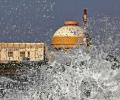
This would make India the world's second-biggest nuclear energy market after China

Banning meat is cruel demonetisation. It is stealing from the poor, nothing less, writes Sunita Narain.

'The Weather Channel argues that India faces the gravest challenge: Climate change-induced health vulnerability.' 'This is an issue often neglected, alerts Claude Arpi: "Prolonged summers, unpredictable rains, floods, droughts, and rising sea levels are the harsh realities of climate change in the country. These factors increase the frequency and severity of illnesses, pushing people into poverty, and forcing migration".'

Indian Railways has to up investment to strengthen network just like China and Russia.

'Presidents may come and go, but America will go on forever,' an American business leader tells Ambassador T P Sreenivasan in New York.

Sebi might come out with a regulatory framework for issuance of 'green' bonds

At the summit, the US is able to play the role of a bully.
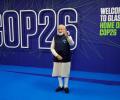
India lost around 38.5 thousand hectares of tropical forest in the last decade. Nearly 14 per cent of the country's tree cover! It is one thing for Modi to announce that India will reach a net-zero level of emissions in 2070. But if it is serious, it needs to start today, points out Ramesh Menon.

The climate conference on Saturday came out with an ambitious final draft that will commit USD 100 billion a year from 2020 to help developing countries.

A glance back at some important events that occurred in 2018.
'Greenpeace has been brutal in targeting both India and the Manmohan Singh government. The push to go after Indian coal is driven by its long-term agenda. What is surprising is that China has not been meted out the same treatment, despite the fact that the rise of China as an economic power has been built around generating power from coal. 'Being richer and more affluent, yet far less democratic, there is less room for an NGO such as Greenpeace to drive home a complicated global agenda, so there is more of a tendency to go along with anything the Chinese offer despite China being the biggest by far with regard to coal use. But for India, it reserves tougher prescriptions, notably for its middle class, says Srinivas Bharadwaj.

Uttarakhand was a tragedy that none of us will forget. As experts analysed the tragedy, it became clear that the disaster was more man made. The intergovernmental panel on climate change in its Assessment Report 5 states that human influence on the climate system is clear and this is evident from the increasing greenhouse gas concentrations in the atmosphere, positive radiative forcing, observed warming, and understanding of the climate system.

India's electric mobility goal, which has so far been riding on two wheels, is all set to graduate to four wheels. At least, the journey has begun. Hyundai Motor India said it would invest Rs 4,000 crore till 2028 to launch half-a-dozen electric vehicles (EVs) in India. It would eventually straddle premium and mass segments. The first of these - the electrified version of an internal combustion engine (ICE)-powered model - will go on sale as early as next year.

The price of wind power may soon compete with conventional fossil fuels, according to researchers in the United States

'The Paris Conference is a decisive meeting on climate change.' 'Negotiating an agreement between 196 countries is indeed a challenge.' 'If we go beyond 2°C, the consequences will be extremely difficult to deal with.'The poor are the most vulnerable to the impact of climate change.'

Scientists at the India Meteorological Department warn that not only has India turned hotter in the last two decades, but that heat waves are projected to become more intense, have longer durations and greater frequency, thereby resulting in more deaths.
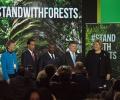
Since the US, the second biggest emitter of greenhouse gases after China, has shifted in a major way to shale gas, the focus of global environmentalists' ire has fallen on India, which is the third biggest emitter, reports Darryl D'Monte.

The joint statement issued after Prime Minister Narendra Modi and President Barack Obama's first-ever summit is high on intent and ambition. Notably missing from the statement is India's refusal to be America's partner in its war against ISIS.

The uproar over 'dams' following the Uttarakhand disaster is ill-informed & potentially counter-productive, says Anand Sankar

'There are 25 million farmers in India with at least 2 to 3 cows each.' 'If all them use biogas to cook, millions of LPG units and firewood can be saved.'

To avert another Uttarakhand-type catastrophe, we must change course. We should stop pandering to the Indian elite's insatiable appetite for electricity, which is driving reckless dam construction, says Praful Bidwai
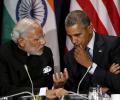
'Big countries do not agree on every set of issues.' 'Look, one of the differences in the relationship is that when we do not agree, we are sitting down and talking to each other.'

'It is in the interest of both sides that the visit of the US President is seen as being successful. Both sides have invested considerable political capital in it. This rapid exchange of visits and the decisions taken have to be justified, beyond the symbolism, which is no doubt important in itself. This opportunity to impart a fresh momentum to ties should not be missed,' says former foreign secretary Kanwal Sibal.

Moving ahead with their new mantra -- Chalein Saath Saath: Forward Together We Go -- Prime Minister Narendra Modi and United States President Barack Obama on Tuesday vowed to deepen cooperation in every sector for the benefit of global stability and people's livelihoods over the next ten years.

This is the joint statement issued by the ministry of external affairs on the visit of US President Barack Obama to India.
 © 2026 Rediff.com - Advertise with us - Disclaimer - Privacy Policy - Sitemap - Feedback - About us - Terms of use - Grievances